Showing posts with label 32 class. Show all posts

21 January 2022

Look! Up in the sky! Is it a bird? No, it’s a loco boiler.

I have been dreading a certain bit of modelling. One distinctive piece of railway infrastructure at Dubbo was the sand tower. It was distinctive due to its height- being the second highest structure in the yard (and probably the city too). Here is a snap from the 1980s.


Thanks to a good mate on the south coast, I happen to have a plan of the tower. The sand container is 24 feet - 7.3 metres.  And it was hoisted 7.7 metres in the air. Yep, 50 feet is a long way up in the air in Dubbo.


The first thing you notice about the plan is that it isn't what got built.  But, with the Railways we all know plans were just to give you the vibe of things.  But I digress...

The sand tower was also distinctive because it was the only time a 57 class worked in Dubbo. To clarify, the sand drum was a condemned 57 class boiler, as noted on the plans.


The tower was also distinctive because it walked. Well, it moved, at least once that we know of. During the steam era it was located to the east of the loco shed, adjacent to the coaling tower. Once diesels needed sand, it the tower walked west to the other end of the shed.

I had resigned myself to not modelling the sand tower because I can’t afford to cut up a brass 57 class. And no one I asked would let me cut theirs up either. But yesterday something weird happened.

I was browsing a Canberra op shop, and did my usual ‘got any toy trains?’ line. In response the lady said ‘we have crates of them out the back’. Oh happy days! I was imagining Lassiter’s treasure trove, with Model Dockyard garratts and Trax 12s and good stuff. I was mildly disappointed therefore to find boxes of plastic British locos, molded to the rails. Yep, the collection of models which came with one of those overpriced magazine subscriptions.

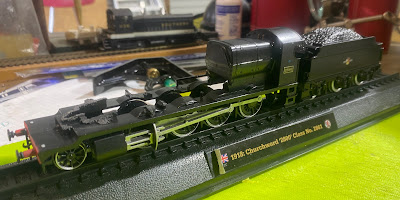
I needed to hide my disappointment and, more importantly, I needed to buy at least one as an act of charity. Then my cunning plan hatched! While none of them looked like a 57, the 1918 Churchward 2800 class looked most like a 57 class.


Well, it sort of did look like a 57 class loco if you screwed up your eyes and pretended the lights were down low. So, No. 2861 became my boiler donor.  Remember, its the vibe!


Today I did some hacking and it may sort of work out okay, sort of, just perhaps. Well, there needs to be some filling and painting and weathering and a support tower need to be built, but or a dark rainy night it may just pass for something like the real thing. Here’s a sneak peak - just a location shot of the half finished water tank next to the half finished loco shed, with the not-quite finished coal stage in the distance, and the boiler sitting on a drill set (obscured).


But really, the sand tower is meant to be a thing in the background, which fixes the location as Dubbo. Here's a snap taken of 3649 hanging out of the western end of Dubbo shed in the mid-1960s (maybe as late as 1967). This is the typical shot I have of the sand tower in its original position - just hanging around as a blob in the background.


So, in that vein, here’s a shot of a hot day in Dubbo in the mid-1970s, where the near-new 4701 has been commandeered to work a trippy from Talbragar ballast siding (editor’s note: the IDR ballast wagons are simply gorgeous). The heat haze and the diesel fumes make it difficult to see the sand tower and coal stage as anything more than a blur.


See you in February!

Cheers

Don

18 January 2022

Recycling is catching

Happy New Year!  I think I can say that still?

New year's resolutions are usually forgotten by about this time of year, or at least I seem to forget them until reminded in August or so.  So I have put mine into action, for once.

It is now three years since we escaped to the country, which also marks about three years since I hauled all my trains in their storage boxes into this part of the world.  And while some of these boxes have been disturbed since, several haven't and aren't likely to until I find evidence of Victorian Railway diesel locos hanging around Dubbo in 1968. 

In other words, finally having a layout which is pitched in a time and place has also finally focused my attention. 

I also discovered that, despite owning a lot of stuff I will never run again, I am in greater need of a whole lot of new stuff.  The immediate need is mainline rolling stock, of the bogie variety.  And there is plenty of 'new stuff' coming on the market over the next two years.  So, I hit the decision point - continue in my railway 'ark filling' approach, or get into recycling.

New Year's Day 2022 was spent finalising a list of items which need to go, and what needs to arrive, complete with estimated prices.  And, happily, they about even out! So I started listing and will continue to until the next round of purchases are funded.

The real winner in all of this activity will be a certain online auction site.  Happily a couple of locos have gone to people in a local club, while several hobby stores have already received the proceeds of sales made in January. And I have been on the same auction site, securing an abode for Dubbo's Darling Street gatekeeper and her family (thanks to a treasured reader of this blog).  So the recycling is going well at the moment.

Which brings me to a couple of mini product reviews. The On-Track Models TRCs and LLVs are just sublime. They run beautifully and look the part. They are so good I have to pair them with my kit built wagons to prevent them running off on my up-and-down trackwork, all on their own. The IDR BBWs are on their way and I suspect I will feel the same about them.  

Conversely, the Austrains FS passenger cars look the part and run like dogs - reminding me why I didn't buy them when they first appeared on the market a decade ago.  Their spoked wheels are going and hopefully that will improve the situation.  Several other bloggers have shown the way to reliable running for these FSs. Thank you to those who have walked this path before me, and written about it.

In all my website scrolling and drooling over what I may need, it became obvious that an additional 32 class was required at some stage.  As mainline rolling stock, rather than locos, is the immediate priority I wasn't really thinking I needed to act.  And then I read a post from one of the Ixion Models owners saying something like, "never say never, but we are unlikely to re-run the C32". Action time!

Within 24 hours, one of the few C32s remaining in the wild was purchased. It arrived last week. I only had the option of a green, maroon or a theatrically-lined 32 class. To remain consistent with the recycling theme of my resolution, I selected green.

Now, I know that even one green P class was unlikely to ever have made it to Dubbo, but now I have two. The Ixion low frame version sits to the right and front of the Trainorama high frame version, considerably brightening the view. 


I know, it is nearly a crime against modelling but both will go under the spray gun at some stage in the future.  I will probably need a cask of rose to get over what needs to be done, but weathered black is the dress requirement for all inhabiting Dubbo loco shed.

Until that dress requirement is enforced, watch for double green Ps on the Coonamble Mail.

Cheers,

Don

PS - the respraying will happen no time soon. It might be a New Year's resolution in 2027 or so.


08 March 2021

Ruminations and reflections

There has been some weird stuff going on in the blogger-sphere around these parts.  

And I am not talking about the odd (very odd) person who offers a range of personal services to my few readers, by commenting on posts about wheat loading at Eumungerie in 1931 and providing a link to a place on the Internet that gives wheat lumpers a completely different connotation.

No, I am talking about the stuff that happens when you write a post and then it disappears, completely, into the Bermuda Triangle of blogs. If this cost goes through, and it is looking promising, it will be attempt Number 3. And that is a shame, because the last two attempts had vastly superior prose.

Colin's thoughtful comments on my last post actually put me back quite a bit.  And its certainly not your fault Colin - your observations made me sit and think, neither of which are my strong points.  The 'essence' - yes, that is what I am after, the essence of a location or a geographic area.

I will get back to the month of ruminations in a minute but part of my thinking has been given to the girth of my layout.  I am very fortunate, Dubbo is not a stretched-out location.  Most of the yard is crammed into 760 metres between the eastern (Fitzroy Street) and western (Darling Street) level crossings.  And I do have plenty of space, as Colin noted.  It means that longitudinally, I only have to compress about 10% to get everything in.

But what about width? Dubbo's railway precinct is also bounded by Talbragar Street on the southern (town) side and Erskine Street on the northern side.  I had paid almost no attention to the width of Dubbo - it was just what I could fit in on an 800mm wide board.

The 'width' of the real Dubbo yard is about 270 metres, but I had limited myself to 125 metres stretching from the dock sidings in the south, to the second or third up siding in the north.  It turns out, that what I am trying to model requires about a 1400mm wide board, and I am giving myself about 60% of that width.  

The compression issue is more acute once you factor in the things that can't be compressed, like station platforms, loco shed, water tanks and coal stages.  Sure, you can nip a few millimetres of each but so many of the NSWGR's pieces of infrastructure were just plain squat and sturdy. 

So that is why 'essence' is back on the table.  

For me, the essence of Dubbo is hearing wheezy, clapped out 30Ts roughly shunt four-wheelers into each other, and the smells of oil, steam and BSVs drying out in the sun.  This latter smell will last with me until death. Hope the others do too.

But I am modelling sight, not sound or smell.  Although DCC Smell might be an innovation which should be pursued.  So, for sight, this is why I haven't been blogging much this past month. 

I have spent many hours scrolling through all the family photos of Dubbo, plus others I have collected along the way.  Thanks to several Facebook groups, and generous participants in those groups, a simple word search of 'Dubbo' uncovers the most amazing treasury of photographs.  Mid-way through this I was lucky enough to 'win' an eBay auction held by an esteemed reader of this blog.  My 'prize' was a bound set of Roundhouse magazines from the early 1980s when the quality of writing and photography was well beyond what you should ever expect from a fanzine.  And the last article in the volume - Dubbo!!!!

I even started charting where most of the memorable steam-era photographs were taken.  It gave me a result not unlike a dogs breakfast. Don't try to read too closely - the green arrows going everywhere give the flavour.

The green arrows have helped me identify the bits of Dubbo that are important to me, which resulted in another scribbly diagram. It left me with what I call the Five Cones of Interest.  Of course, this should be of little interest to anyone other than me, but here you go for posterity.  The dark blue dots are where a person would be standing to view the 'cone'.


The Five Cones now means that I am much more interested in getting five key (for me) spots on the layout just right, not the whole thing.  Sure, I would like the whole thing to smell of Dubbo, but until someone 3D prints a 57 class boiler just so I can tip it on its end and point it skyward, it will be missing from this layout.

Anyway, the Five Cones has led me to better understand that the essence of a location can be found in just a few angles.  One of the important for me is Cone 3, standing on the eastern end of Dubbo platform, looking across to the loco shed.  Here's a snap of 3144T and 3203 being prepared for a tour on 10 April 1966, which apparently was a bright, sunny day.


All of a sudden the task  isn't as big as it once was.  To get something I might be happy with will involve:

* finishing off my loco shed to a crappy standard (good at that)

* dropping a commercially available water column and yard lights in at the right spots

* figuring out what the wagon on the ground is (is it a KKG?) and replicating

* knocking up a couple of very plain fibro huts.

And of course, I will be modelling this scene 10 minutes after the locos have been put back into the shed for the night, so I don't have to clean any loco wheels.

So, for me, until scratch and sniff sheep wagons come onto the market, the essence of Dubbo will be my Five Cones.

Now, who reckons that is a KKG on the ground?  Maybe it was the culprit for all those smells over 50 years ago?

And very finally, on behalf of the many more readers that the Essence blog has, Colin, we are all eagerly waiting for Moblayne to rise!

03 May 2020

Three gems emerge

Things keep falling out of the family photograph collection as various family members self isolate.  I hadn't seen these three photographs until last Friday.  

First up, 3028T shunts a BSV bogie sheep van in Dubbo yard in the early part of 1968 when its locally-applied royal blue livery was still relatively unfaded. 


Probably snapped on the same visit to this region, just up the Newell Highway at Eumungerie the locals were celebrating the opening of their new wheat bulkhead. It wasn't just a great asset for the local farmers - when empty it was also a terrific indoor cricket venue.  It is difficult to imagine these days, but these facilities were routinely left unlocked which was just inviting inspection and nefarious use.


And this third photo is of 3289, crossing the Fitzroy Street level crossing in Dubbo, around 1970.  Although the loco's cab numbers are obscured, its at-the-time unique NSWGR sand box embellishment confirms its identity. 


If these sorts of photographs keep coming to light, I really have no problem with being isolated for another three months or so.

Cheers,
Don

24 December 2016

Same spot, different times


I have been pondering the essence of locomotive depots recently - what is absolutely essential, what is probably needed and what is otherwise nice to have. This pondering led me to think a little about Dubbo's depot - which was pretty small (geographically speaking) relative to most other NSW loco depots. And this pondering even led me to assemble a montage of photographs, taken from nearly the same spot over the last 50+ years. 

I won't bore you with all the photographs - lets just have a look at one every 10 years or so.  What has struck me is the weird stuff - things moving around and other things just hanging around long past use-by dates.

Lets start with a baseline in January 1967 - this shot is a bit closer than the others I will post. Apart from showing 3649 and a P class shunting a S wagon with a very clean tarp, the position is clear from the palm tree and the edge of the signal gantry.  At this time there is the old shed in the process of falling apart, alongside the newer shed.  A line of buildings forms the northern edge.

Fast forward to May 1979 and... it is eerily similar.  OK, the old shed 'fell down' but we have steam era gantries and buildings.  The trees remain and a steam boiler balances on its end further down the yard as a sanding tower.


Jump forward to October 1987 and there has been some change - the diesel fuel pad has been installed and the steam boiler has wandered westward to a position adjacent to the pad. The shed is still there, and so are the trees.  Hey, there is even a S wagon in the shade of the shed.


Next stop, 1997. The shed, fuel pad, sanding tower and even the S wagon are still all there. What's new? The locos are larger - 8213 almost seems to be cramped inside the fuel pad. And those trees - is that new growth?


Onto 2005. Shed, tick. Fuel pad, tick. Wandering sanding tower, tick.  The trees look healthy- even the one which has grown in front of the shed in the right of way - so the shed is there but not being used? At least the western end of the shed is not accessible. And our S wagon (I am presuming it is the same one) has traveled back down its track to the eastern end of the shed.


OK, last one - 2012. The sanding tower has gone, so has the S wagon. The buildings that remain are boarded up. The western end of the shed is no longer obscured by foliage and the palm trees look like they have had a haircut. Has there been a renaissance for the shed? Sadly, no. zoom in and you may be able to pick out the fine lines of mesh across its entrance.  A close check of the roof gives an indication of its purpose - it is a very large pigeon loft.


So, I could go on and on and on but it is Christmas and we all have better things to do. In a reductionist world, what is the essence of a NSWGR loco depot? I think it could be palm trees and S wagons.  All the rest is relatively impermanent! 

Merry Christmas folks!
Don

22 October 2015

Stockies

Its been too long! I was scrolling through the diminishing list of photos of Eumungerie, thinking of what next to inflict upon you poor sods. Then I found these... four photographs taken over the course of a decade or so with one common element - beasts.

The first is from the mid-1960s and it has 3004T headed south with a two BSVs loaded with sheep and then a BCW. Probably a fair few beasts loaded into other wagons out of view too.


I thought the last photo was a bit strange in that wagons moving sheep and cattle were adjacent to each other on the same train - my otherwise tidy mind prefers to remember stock trains loaded with steaks or chops, but not mixed grills.

Then I looked at the next photo - its the four wheel version of the same thing. This time its a GSV immediately behind 3262, then a CW.  This time the beasties leaving the Coonamble branch were being accompanied by an empty ballast wagon, and probably others. Keen eyed observers may also identify another beast - in the form of a young laddie, scurrying away.


The pattern of beef and sheep is continued in this shot of 3203 headed north, with empties.  The date is 13 April 1966.


And finally, about a decade on, the motive power has changed but not the rolling stock. A morning northbound pickup, led by 4910, has a string of at least eight cattle wagons. Within that string there is still variety in style and hue.


Its time to leave the beasts of yesteryear - the steam powered, the internal combustion and the grass fed ones.

Ciao for now!
Don


12 May 2015

Turning locos at Coonamble

Just a quick blog to publicise a terrific little article by Jim Stokes in this month's Railway History on turning C32 class locos on the 50 foot turntable at Coonamble.


Not only does the article star one of my favourite Dubbo 32s, 3230, it is a nicely illustrated and informative short article about a process I would never have seen (because if I had travelled 154 miles on a mixed on a Saturday, knowing that there was another 154 miles to go, I would have gone to the pub).

Having now read the article about 5 times I still can't work out who had the worse job- the fireman who got to push the turntable or the driver who had to hang onto the rear end of a tenderless 32 class.

If you have a spare $8.40 it's a bargain!


Ciao for now!
Don

14 February 2015

A few memories of wheaties at Eumungerie

Given that I have written more about grain traffic on the Coonamble branch than any other human (how's that for a claim to fame?) I should really know 'stuff', but I don't. It falls to the generosity of time and spirit of others to improve my education, along with a couple of decent national institutions. I am going to drag a few of these influences together in this post.

First, a very straightforward explanation of peak season wheat train workings in the Eumungerie area provided by my father...

When the peak was on, a train of empties would arrive early and drop off the Eumungerie allocation on the silo track. These would be gravitated or barred to the chute and loaded. 

In the afternoon a loco (tender leading) and van would arrive from Dubbo and pick up the now loaded train and return it to Dubbo. The original would have continued on dropping off empties as allocated towards Gilgandra. 

As this area of land was marginal for wheat growing, there was extensive use of superphosphate.  This came from Newcastle or Port Kembla in tarped 'S' trucks. These were often added to the afternoon engine/van train and placed on the loading bank or near the crane.

Finally in the late afternoon the original loco would come back from Gilgandra and head to Dubbo with its loaded train.

Second, many will know of Col Hussey's most excellent blog Essence, worth reading both for the HO railway under construction and Col's explanation of real life operations on the NSWGR. Through the Aus_Model_Rail chat group Col recalled that during the large 1964/65 wheat harvest, trains that operated from Dubbo as far as Gilgandra were worked by bogie tendered 32 class as there was a triangle there to turn them there.  On specials that ran as far as Eumungerie they ran tender first out and engine first back. So, I think we have corroboration!

Finally, the benefit of having decently resourced national institutions? I refer in particular to the National Library of Australia's Trove website which contains 15,000 references to Eumungerie alone. It also has a series of photographs taken in December 1958 by a Mr J Tanner. I am reproducing several of the series below to illustrate the wheat loading process at Eumungerie.

First up, the morning train has been out and deposited a collection of BWH and RU hoppers on the silo road. One BWH has been loaded and a RU is in the process of being loaded.


Here is a close-up of the RU being loaded - great OHS!


Inside the road receival facilities farmers were either dumping bulk grain, or emptying bagged grain.
 

Emptying bagged grain would have been particularly lousy and hot work. Lucky this bloke is well dressed for it!


Finally, other farmers have a decent wait, especially if every bag needs to be emptied. Note the loaded BWH and directly behind it, a rare shot of the station officer's residence.


I strongly encourage everyone to log onto the Trove site - it is a national treasure.  I'll refrain from calling Col and my father national treasures, but they are very useful sources!

Ciao for now!
Don

25 January 2015

Dubbo's steam shunters

Yes, it has been a while but for once it hasn't been my slackness or distractions... my 'telco service provider' hasn't been able live up to its name since the week before Christmas.

My last post involved LVR's esteemed P class, 3237. I don't have any shots of it at Eumungerie or working the Coonamble branch, but I do have a collection of steam locos shunting Dubbo yard in the 1960s which does include 3237.  So I thought I would dig them up.

When sorting the photos I have been a bit sidetracked by 30T tenders - the forthcoming 30T model by Shrike Models being in the back of my mind (and wallet). So, tenders is a bit of a focus for the first few photos. First up, 3055T with its bogie tender.


3080T has the standard 30T six-wheel tender.


3102T has the less common narrower, six-wheel tender nicked from a scrapped Z16 class loco.


Here is two shots of 3122T, and I don't know what chronological order they should be in.  They are evidence however that 30Ts swapped tenders from time to time. Here is 3122 with a bogie tender.


And here it is with a six-wheel tender.  OK, the front of the loco has been cropped off by the photographer, but the interest in this particular shot is the antiquated equipment being used to make repairs to the driving rods (note the slide rods cover is off).


The last of the 30T collection for the time being is 3142T in the distance. Take my word for it! I love this photograph for the quality of the roof on the shed and the ash stacked high in the S wagon in the foreground. Great character!

 
If you haven't had enough of 30Ts, scroll down to my post in May 2014 (or click this link) to see blue 3028T with a bogie tender and green 3144T with a six wheel tender and extended smoke box.  Unfortunately I don't have any photos of a 30T at Dubbo with a Baldwin tender! Leaving 30Ts we return to the loco which started this post - 3237.


I think I may have posted the following photo before? Anyway 3289 looks so nice it deserves another run.


For the last shot it is time to take a peak at Dubbo's own standard goods - 5408.


Its good to be back on the air... ciao!

03 December 2014

A Christmas tradition

One of the best Sydney Xmas traditions is the Special Kids Christmas Special.

Each year 3801 Ltd runs a special train to Rosehill Gardens for unlucky kids who are lucky for at least a day. Today is that day.

Today 3237 is on the front...


There is a connection with Eumungerie, as 40 years ago this loco was a Dubbo loco. And today it looks better than it did then.


It will be a hot one for the crew.


And an immaculate 4501 tails the 10 carriages.


Always good to see a P in Sid-en-née. Repeat after me... Always good to see a P...

Ciao for now!
Don

24 November 2014

Not where I thought?

Here is a photograph of a fairly everyday experience from about 1965 (I think).

The loco in question - 3222 - was allocated to Dubbo in 1965 and 1966. It looks like the train it has behind it is a very healthy up pickup, with wool and wheat loading. 

The railway precinct is also rather interesting - the edge of the turntable can be seen, along with the water tank and carriage shed. Gillespie Bros. flour mill can be seen in the background, along with a relatively rare Metcalfe silo.


I had always had this photograph pegged as Gilgandra - principally due to the fact that the word 'Gil' was written on the slide mounting frame! Fairy reasonable conclusion to draw...

But now am not so sure. I am fairly sure the Metcalfe silo is out of town, and Gilgandra had a turning wye rather than a turntable (or maybe both?).

Wherever it is, its a cracker as a modelling proposition given most of the major infrastructure is on one side. Dead flat too.

The clue to where it is - and it may yet be Gil - may lie in the S trucks at the front of the train.  It appears that the second is part filled with some sort of uncovered aggregate or rock.

Enjoy the mystery!

02 March 2014

The 1954 Royal Tour

Probably the busiest day ever for Eumungerie and the entire Coonamble line was 10 February 1954 - and I have forgotten to mark the 50 year anniversary of this event (three weeks ago).  So, lets get started...

At the time, the usual scheduled rail services were composed by a single return passenger service running daily except Sunday, and a mixed pick-up operating thrice weekly.  However, on Wednesday, 10 February 1954, additional and altered train arrangements for the Coonamble line were put in place in order to convey passengers to Dubbo to meet Queen Elizabeth II on her first royal tour.

The first additional train operated was an empty car movement from Dubbo at 2:00am on the day, resting at Eumungerie for three minutes from 2:49am and reaching Coonamble at 5:44am.  This train formed No. CC Up Passenger departing Coonamble at 7:00am.  It arrived at Eumungerie at 9:55am, and was held at this location for 17 minutes in order to cross No. 45 Down Coonamble Mail.  The up service arrived at Dubbo at 11:00am.

The second additional service was formed by cars off No. 59 Down Passenger the previous Saturday.  It left Dubbo as an empty car movement at 3:00am on Wednesday morning, and also spent three minutes at Eumungerie from 3:49am.  Arriving at Coonamble at 6:44am, it left at 8:10am as No. JJ Up Passenger to Dubbo.  This train crossed No. 45 Down Coonamble Mail at Gilgandra, passed through Eumungerie at 11:16 and arrived at Dubbo at 12:05pm.

The third additional service was provided for school students, as well as the general public.  The positioning run to Gilgandra left Dubbo as No. 31a Down Passenger at 5:45am, being formed by the cars from the previous day’s No. 31 Down Passenger, meaning that it conceivably was a loco-hauled RUB set.  This service also took three minutes to work through Eumungerie – this time at 6:34am.  Arriving at Gilgandra at 7:13am, 32 minutes later it returned to Dubbo as No. 28a Up Passenger.  This service passed through Eumungerie at 8:26am.

The final morning service involved the usual mail train working, albeit to an altered timetable.  No. 45 Down Coonamble Mail left Dubbo 44 minutes later than its usual departure time of 8:06am.  As noted above, it passed No. CC Up Passenger at Eumungerie and No. JJ Up Passenger at Gilgandra.  It arrived at Coonamble at 12:42pm – 62 minutes later than its usual arrival time.

The evening return services were led by No.45G Down Railmotor, which left Dubbo at 5:10pm, passed through Eumungerie at 5:52pm and arrived at its terminus of Gilgandra at 6:26pm.  It returned 10 minutes later, as No. 46G Empty Railmotor, running through Eumungerie at 7:06pm to arrive at Dubbo by 8:15pm.  If required, the same railmotor set then formed No. 47G Down Railmotor service, which is described below.

The first evening loco-hauled passenger service was run for school students only, departing Dubbo at 6:20pm as No.10C Down Passenger.  It crossed No. 46G Up Railmotor at Eumungerie at 7:09pm, and arrived at Coonamble at 10:08pm.  This train returned to Dubbo as No. RC Empty Passenger at 11:30pm, arriving at Dubbo by 3:46am on 11 February, then working through to Orange.

The second evening loco-hauled passenger service departed Dubbo at 7:40pm as No.15J Down Passenger.  It arrived at Eumungerie at 8:29pm, and arrived at Coonamble at 11:30pm.  This train returned to Dubbo as No. RJ Empty Passenger at 12:50am on Thursday morning, and would then form No. 58 Up Passenger on the Friday. 

I don't have a photo of the day's events from my (possibly republican) family and the only railway-related photograph of the day that the internet comes from the excellent NSW Records site.  The following snap shows an immaculate 3306 ready to return royalists to Nyngan.


The photo gives the clue that a mixture of 30T and 32 class locos were pressed into service for the event.

Thus ended quite possibly the busiest single day for passenger traffic on the Coonamble line.

How did it all go? Well, the Queen visited for a whole 90 minutes, after landing at 3:30pm.  She got to see a whole bunch of sheep bums... (another one from NSW Records).


The Sydney Morning Herald reported the following day that:


The Royal party... landed at Dubbo in bright sunshine and the town give them an overwhelming welcome... The big event of the programme was a visit to a typical country show.  Here was a new, friendly easy-going world of men in broad-brimmed hats, bushmen in athletic singlets and trousers, of sheep "hearing, tree-felling and whip-cracking. 

The Queen was obviously delighted by the novelty of it all-by the guard of honour of rows of prize rams and ewes, by the cheery wave she got from an axeman in a tree felling contest.
Enthusiasm steamed from the Dubbo crowds...

Enough for now!


05 January 2014

Starting 2014 with a P

Happy New Year!

One of my resolutions this year is to finish off the 'great pre-war history' of grain transportation along the Coonamble branch line. This should enthuse the few readers of this blog as much as it does me!

In the meantime, just to keep faith with my loyal few readers here is 3230 on a down empty wheat at Eumungerie in September 1967.