21 January 2022

Look! Up in the sky! Is it a bird? No, it’s a loco boiler.

I have been dreading a certain bit of modelling. One distinctive piece of railway infrastructure at Dubbo was the sand tower. It was distinctive due to its height- being the second highest structure in the yard (and probably the city too). Here is a snap from the 1980s.


Thanks to a good mate on the south coast, I happen to have a plan of the tower. The sand container is 24 feet - 7.3 metres.  And it was hoisted 7.7 metres in the air. Yep, 50 feet is a long way up in the air in Dubbo.


The first thing you notice about the plan is that it isn't what got built.  But, with the Railways we all know plans were just to give you the vibe of things.  But I digress...

The sand tower was also distinctive because it was the only time a 57 class worked in Dubbo. To clarify, the sand drum was a condemned 57 class boiler, as noted on the plans.


The tower was also distinctive because it walked. Well, it moved, at least once that we know of. During the steam era it was located to the east of the loco shed, adjacent to the coaling tower. Once diesels needed sand, it the tower walked west to the other end of the shed.

I had resigned myself to not modelling the sand tower because I can’t afford to cut up a brass 57 class. And no one I asked would let me cut theirs up either. But yesterday something weird happened.

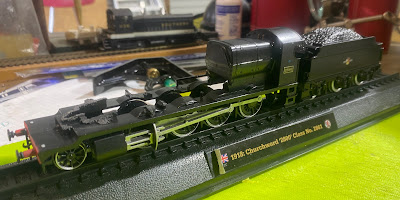
I was browsing a Canberra op shop, and did my usual ‘got any toy trains?’ line. In response the lady said ‘we have crates of them out the back’. Oh happy days! I was imagining Lassiter’s treasure trove, with Model Dockyard garratts and Trax 12s and good stuff. I was mildly disappointed therefore to find boxes of plastic British locos, molded to the rails. Yep, the collection of models which came with one of those overpriced magazine subscriptions.

I needed to hide my disappointment and, more importantly, I needed to buy at least one as an act of charity. Then my cunning plan hatched! While none of them looked like a 57, the 1918 Churchward 2800 class looked most like a 57 class.


Well, it sort of did look like a 57 class loco if you screwed up your eyes and pretended the lights were down low. So, No. 2861 became my boiler donor.  Remember, its the vibe!


Today I did some hacking and it may sort of work out okay, sort of, just perhaps. Well, there needs to be some filling and painting and weathering and a support tower need to be built, but or a dark rainy night it may just pass for something like the real thing. Here’s a sneak peak - just a location shot of the half finished water tank next to the half finished loco shed, with the not-quite finished coal stage in the distance, and the boiler sitting on a drill set (obscured).


But really, the sand tower is meant to be a thing in the background, which fixes the location as Dubbo. Here's a snap taken of 3649 hanging out of the western end of Dubbo shed in the mid-1960s (maybe as late as 1967). This is the typical shot I have of the sand tower in its original position - just hanging around as a blob in the background.


So, in that vein, here’s a shot of a hot day in Dubbo in the mid-1970s, where the near-new 4701 has been commandeered to work a trippy from Talbragar ballast siding (editor’s note: the IDR ballast wagons are simply gorgeous). The heat haze and the diesel fumes make it difficult to see the sand tower and coal stage as anything more than a blur.


See you in February!

Cheers

Don

18 January 2022

Recycling is catching

Happy New Year!  I think I can say that still?

New year's resolutions are usually forgotten by about this time of year, or at least I seem to forget them until reminded in August or so.  So I have put mine into action, for once.

It is now three years since we escaped to the country, which also marks about three years since I hauled all my trains in their storage boxes into this part of the world.  And while some of these boxes have been disturbed since, several haven't and aren't likely to until I find evidence of Victorian Railway diesel locos hanging around Dubbo in 1968. 

In other words, finally having a layout which is pitched in a time and place has also finally focused my attention. 

I also discovered that, despite owning a lot of stuff I will never run again, I am in greater need of a whole lot of new stuff.  The immediate need is mainline rolling stock, of the bogie variety.  And there is plenty of 'new stuff' coming on the market over the next two years.  So, I hit the decision point - continue in my railway 'ark filling' approach, or get into recycling.

New Year's Day 2022 was spent finalising a list of items which need to go, and what needs to arrive, complete with estimated prices.  And, happily, they about even out! So I started listing and will continue to until the next round of purchases are funded.

The real winner in all of this activity will be a certain online auction site.  Happily a couple of locos have gone to people in a local club, while several hobby stores have already received the proceeds of sales made in January. And I have been on the same auction site, securing an abode for Dubbo's Darling Street gatekeeper and her family (thanks to a treasured reader of this blog).  So the recycling is going well at the moment.

Which brings me to a couple of mini product reviews. The On-Track Models TRCs and LLVs are just sublime. They run beautifully and look the part. They are so good I have to pair them with my kit built wagons to prevent them running off on my up-and-down trackwork, all on their own. The IDR BBWs are on their way and I suspect I will feel the same about them.  

Conversely, the Austrains FS passenger cars look the part and run like dogs - reminding me why I didn't buy them when they first appeared on the market a decade ago.  Their spoked wheels are going and hopefully that will improve the situation.  Several other bloggers have shown the way to reliable running for these FSs. Thank you to those who have walked this path before me, and written about it.

In all my website scrolling and drooling over what I may need, it became obvious that an additional 32 class was required at some stage.  As mainline rolling stock, rather than locos, is the immediate priority I wasn't really thinking I needed to act.  And then I read a post from one of the Ixion Models owners saying something like, "never say never, but we are unlikely to re-run the C32". Action time!

Within 24 hours, one of the few C32s remaining in the wild was purchased. It arrived last week. I only had the option of a green, maroon or a theatrically-lined 32 class. To remain consistent with the recycling theme of my resolution, I selected green.

Now, I know that even one green P class was unlikely to ever have made it to Dubbo, but now I have two. The Ixion low frame version sits to the right and front of the Trainorama high frame version, considerably brightening the view. 


I know, it is nearly a crime against modelling but both will go under the spray gun at some stage in the future.  I will probably need a cask of rose to get over what needs to be done, but weathered black is the dress requirement for all inhabiting Dubbo loco shed.

Until that dress requirement is enforced, watch for double green Ps on the Coonamble Mail.

Cheers,

Don

PS - the respraying will happen no time soon. It might be a New Year's resolution in 2027 or so.


06 December 2021

Let the light shine on

 I will post a few more shots of progress with the HO layout just as soon as I get on top of this mowing (in May 2022 probably), but here's few shots of Eumungerie's station lamp case.  And before you wonder, no, we didn't steal it... 

We were pretty devastated in the mid-1980s to pop out to Eumungerie to find that the last station building had been dragged sideways and torched.  Amid the ruins, this little beast was just sitting there, waiting for a new home.  It has been carefully stored ever since and one day it will again light the way to Eumungerie.  Though this time it will be a solar powered light.  


And the cutest cap.


Back to the mowing.


Cheers!

Don


22 August 2021

Fitzroy Street takes shape

And just like that, it has warmed up in these here parts of Australia.  

It is now balmy in the shed, and that is not just my considered opinion.  It is the opinion of a family of swallows who have decided to nest in one of the rafters.  These charming little rats with wings used the same spot last year, so it has been a bit of a running battle to evict them.  I seem to have found their current access point, which is no larger than a HO loading gauge tool (I checked).  It is now plugged and I think I am alone now up there.

A number of projects have advanced since the last post which covered the construction of Dubbo B Signal Box.  I was pretty happy with how that effort turned out, until I discovered a photo of its eastern wall a few days after declaring the project complete.  Here's a photo of what I should have modelled on, bearing in mind this is supposed to be a skillion roof.  Just look at the kink!

So, it really was a standard skillion roof signal box, but with a kinky eastern profile, chimney and pole growing out of the roof. Makes the textbook version I modelled seem rather bland.

But progress continues! B Box needs its shunters' cabin for company, and so I built a version based on the original plans, plus a bit of license to build the chook shed extension at the western end of the cabin. 

And these are thirsty signalmen and shunters, so there was an immediate need to build the Railway Junction Hotel, which has sated the thirst of many a traveler through Dubbo. It also had a great vantage point over the railway crossing, which I can personally testify to from the front bar.

The Railway Junction Hotel is welcoming, but it would never win a beauty pageant. So, unsurprisingly, there is no similar hotel model on the market currently.  So I rummaged through the unmade-kits box to discover these from Woodland Scenics. Yes, they don't look much like a pub either. 


Anyway, I started jamming this with that and soon enough something that looked a bit like a pub started to emerge.  The following shot shows the signal box, shunters cabin and the pub.  All need a few details, like chimneys, a door for the signal box and steps. An order from Uncle Joe to arrive this week should resolve a few of these missing elements. Ignore the colours of the models in the next few photos - once lockdown is over I am off to buy paint. But I am somewhat satisfied with how things are going.


One of the photos of Dubbo that has been emailed to me over the years really stuck in my mind.  Sorry, the photographer's name didn't.  It may have been Weston Langford.  It is this one of 3122T shunting in front of the Railway Junction Hotel.

Long way to go, but I can see something similar emerging.

The other thing missing from the western side of any Fitzroy St scene is something that fulfills the function of Furney's Stockfeeds - a corrugated iron clad industry which gives you something to shunt other than wheat and fuel wagons.  It has a sentimental attachment - my three chickens regularly eat Furney's products well into 21st century. And so it was back to the unmade-kits box. This time I found a couple of items which were built in the early 1990s as a low relief background, but never progressed (until last night).

I have no recollection of what Furneys looked like in the 1960s, but I can assure you that it has never been a double-story brick building, but it is now.  The one thing I do remember was the word 'Furneys' painted across the roof.  This will happen once I am again able to wander unchecked in the model shops of this land.  In the meantime, (a Bergs white metal with Classic chassis) 4913 has shunted its first empty into Furneys. Patrons of the Railway Junction Hotel can experience GM goodness in stereo.

And so to my final indulgence for this post. Again, there is a lot to finish and nail down but I really want to have a few 'peek holes' around the layout.  One will be looking out through the doors of the Railway Refreshment Rooms (RRR). I can recall sitting at a plain table with a milky pot of coffee, waiting for my baked beans on toast to be warmed and served. In my mind I can still see the mail train that had deposited me there earlier that morning.  

The shed can't yet serve milky coffee and baked beans, but I have built a shell of the RRR building façade.  Again, I have used the 'essence' license and gone totally rogue with the doors which were never that grand in real life but give me enough width to see into the yard.  There is a lot wrong with the following photo, including the asphalt on the platform not sitting down properly, but it gives an idea that the smell of baked beans in the morning is not too far away. 

That's enough from me this week. Keep away from the Spicy Cough comrades!

Cheers

Don


03 August 2021

When modelling comes indoors

Its been a cold winter in these parts - down to minus most mornings and the train shed never gets above 10 in July and August (this year it started in May).  It isn't much fun watching a 30T shunt when you can't feel your fingers or toes, even under several layers of clothing.  So this is my way of confessing to (a) being soft in my old age (b) reluctant to spend time in the shed these part few months.  Don't worry, give it four months and I'll be complaining about the heat.

Anyway, while sitting inside next to the fire I have been inspired by the most excellent series of books by Bob Taafe on signal boxes of NSW.  The drawings in the books are a modeler's treasure chest and the maps are pretty darn good too (thank you Mr S).

As I sat there, inspired, I counted up the number of signal boxes I will need for the layout - 12! Including four in Dubbo itself, plus Dubbo East and Troy Junctions!  And no two are the same. That is a lifetime of scratch building at the rate I achieve things.  The load will need to be lessened by purchasing one or more kits, but it is still a decade of (under) achievement, even counting that I have 2.5 boxes already made. 

All this is a way of saying I have made a start on Dubbo B box, which sat on the southwestern corner of the mainline as it crossed Fitzroy Street.  According the Taafe bible, the first Dubbo B box was on the northern side of the line.  This was replaced by the one I want to construct in 1936.  The replacement was, as described by Bob Taafe, the 'classic NSWR country signal box' - skillion roof, weatherboard walled and known by the owners as the 'standard low elevation signal cabin'. 

As kids, we would regularly be held up here to see a 30T wheeze by, shunting the yard.  So, it came with my usual sense of disappointment to find we had no photos of the box prior to its re-sheeting in the early 1980s into a truly horrid looking box. Then we have plenty of the new iteration.

Bob Taafe points out that the primary purpose of the signal box was to shelter the officer in charge of opening and closing the Fitzroy Street railway crossing gates, as the signals were worked from Dubbo A box on the station platform.  And that is what I remember most - the bum side of a laconically posed worker, usually with a cigarette hanging our of his mouth, leaning up against the gate, also watching the 30T wheeze by.

Thankfully, I managed to find several good shots on various Facebook groups, which confirmed that Dubbo B box varied from the standard design (along with many other examples) with a door on the eastern end, rather than out onto a small platform. The following photo is a snippet of a great shot published in Derek Rogers's book, Remember When.  I have stolen this particular photo because it also shows my next modelling project - the shunter's cabin aka the chook shed.

The other reason I picked Dubbo B box is that it was a solid wall on the high (southern) side, which is the side most people will view it from on the layout.  Solid walls are my modelling forte.

Armed with all this information, I nearly built the whole box in a day.  Probably my fastest effort ever as I like to stop to sniff the glue as it dries.  Here's a bit of evidence.


The windows are undersized against the prototype, but they are a North Eastern product so they are a joy to work with.  I added another pane of windows to make up for the narrowness of the North Eastern ones.  And I impressed myself by remembering to not glue the roof on before it is painted and the window glass inserted.  

Here is a close up from the north western end - the window frames look a bit wonky as they are only sitting there. Every photo I have of this box, the west end window is open, so it is too in the model.  I am OK with the way it looks.  Chimney pot, guttering and telegraph wires to be added, along with a black snake sliding under the foundations.

And yes, it will be painted at some stage.  On 19 March 1964 a gentleman by the name of Howard Simpson took a lovely photo of 3080T in the vicinity of Dubbo B box, which another gentleman (Chris Sim) posted on Facebook.  I have snaffled the right hand 30% of that photo and reproduced it below, as it will be my guide for painting when that time comes.  It was once a very handsome box!


So, I am off to do another signal box in August, probably Troy Junction.  But I will be building that one our of inflammable materials as the prototype had a propensity to combust.

Thanks to all who contributed to this imperfect near-rendering of Dubbo B box - Messrs Taafe, S, Rogers, Simpson and Sim.  See, it takes a village to raise a signal box.

Cheers,
Don


19 April 2021

Easter Progress

I figure I should pop up a post because sometimes things work out better than one plans - and faster too. A couple of posts ago I wrapped 2020 as being a year of great achievement as I had managed to establish my version of the Coonamble branch (everything is relative - but the previous decade had been a zero achievement zone).

I am not ashamed to claim that you can have a whole ball of fun with a 3 station branch line.  Just running a wheatie out and back, plus a railmotor can soak up an hour.  And until I get a couple of back boards in, I always have the thrill of possibly running right through the terminus and dropping 4 feet to the concrete floor.  This fact alone makes the crew stay attentive.

Here is CPH 3 arriving at Pilliga, otherwise known to the locals as Central Plywood. The photographer is about to derail the railmotor if necessary to stop its plunge.


In the recent Easter holiday period, 4910 has been deputising for the the railmotor - captured at Coalbaggie Creek on 27 March. Control wishes to advise that the use of a diesel and passenger carriages is only due to the expected increase in patronage, and not because the CPH is out of service being fitted with a bungee cord.  

Running the branch is turning out to be quite a time chewer.  However, I had promised myself not to let another year slide by.  So I had set the goal of laying our Macquarie (Dubbo) and getting a little loop going for the days/times when I am feeling less energetic.

The little loop arrived first.  It links Troy Junction (actually the mirror reverse of Troy) with the line which heads west from Macquarie. I hope you can follow this! Anyway, it means that a train heading west from Macquarie circles back and ends up being a train coming off the Dubbo-Merrygoen cross country line.  The main track of this loop line is laid, but I will wait to procure sufficient Peco points to finish it before I post more about Balliminore (yes, a clever combination of Minore on the GWR and Ballimore on the cross country line - thank you, no applause for the genius of working that one up).

The following non-drone shot was taken from high above West Macquarie, which is just as flat and featureless as West Dubbo in real life.  It shows a half laid Macquarie yard and the loop to the left. 


So, finally to laying Macquarie yard.  The best that can be said is that it is complete as of last weekend.  Owing to the lack of new Peco points along Australia's eastern seaboard (just who is modelling Enfield or Dynon?), the yard includes points so old they have gouges from Triang B classes. When the Peco container ship arrives at Port Botany I shall be dockside!

Anyway, the yard works.  I can shunt to my heart's content. The basic structures which scream 'Dubbo' to me - the station, the Harman coal stage, the 3 road loco shed and the carriage shed - all fit. The bit of paper you can see in the middle of the next photo is a HO scale 60 foot Sellars turntable. Lots more has to happen but at last my modelling to blogging balance is where I would like it to be.


I suspect not much more observable progress will happen this year.  A few buildings may emerge but the next phase is under the layout - my electrician needs to spend some quality time under the boards!  But, more importantly, I just need to run the layout lots to see if I can break what I have done.  This is almost certain to be achieved!

If you will indulge me one final photo, it comes from the late 1950s at Macquarie.  The west end of the loco shed suggests that it must be a weekend, with 1221 squeezed between 3016T, 3298 and another 30T.  In the background an infidel diesel lurks - a Lima 44 has made an appearance and is skulking into the east end of the shed.


Cheers!

Don


08 March 2021

Ruminations and reflections

There has been some weird stuff going on in the blogger-sphere around these parts.  

And I am not talking about the odd (very odd) person who offers a range of personal services to my few readers, by commenting on posts about wheat loading at Eumungerie in 1931 and providing a link to a place on the Internet that gives wheat lumpers a completely different connotation.

No, I am talking about the stuff that happens when you write a post and then it disappears, completely, into the Bermuda Triangle of blogs. If this cost goes through, and it is looking promising, it will be attempt Number 3. And that is a shame, because the last two attempts had vastly superior prose.

Colin's thoughtful comments on my last post actually put me back quite a bit.  And its certainly not your fault Colin - your observations made me sit and think, neither of which are my strong points.  The 'essence' - yes, that is what I am after, the essence of a location or a geographic area.

I will get back to the month of ruminations in a minute but part of my thinking has been given to the girth of my layout.  I am very fortunate, Dubbo is not a stretched-out location.  Most of the yard is crammed into 760 metres between the eastern (Fitzroy Street) and western (Darling Street) level crossings.  And I do have plenty of space, as Colin noted.  It means that longitudinally, I only have to compress about 10% to get everything in.

But what about width? Dubbo's railway precinct is also bounded by Talbragar Street on the southern (town) side and Erskine Street on the northern side.  I had paid almost no attention to the width of Dubbo - it was just what I could fit in on an 800mm wide board.

The 'width' of the real Dubbo yard is about 270 metres, but I had limited myself to 125 metres stretching from the dock sidings in the south, to the second or third up siding in the north.  It turns out, that what I am trying to model requires about a 1400mm wide board, and I am giving myself about 60% of that width.  

The compression issue is more acute once you factor in the things that can't be compressed, like station platforms, loco shed, water tanks and coal stages.  Sure, you can nip a few millimetres of each but so many of the NSWGR's pieces of infrastructure were just plain squat and sturdy. 

So that is why 'essence' is back on the table.  

For me, the essence of Dubbo is hearing wheezy, clapped out 30Ts roughly shunt four-wheelers into each other, and the smells of oil, steam and BSVs drying out in the sun.  This latter smell will last with me until death. Hope the others do too.

But I am modelling sight, not sound or smell.  Although DCC Smell might be an innovation which should be pursued.  So, for sight, this is why I haven't been blogging much this past month. 

I have spent many hours scrolling through all the family photos of Dubbo, plus others I have collected along the way.  Thanks to several Facebook groups, and generous participants in those groups, a simple word search of 'Dubbo' uncovers the most amazing treasury of photographs.  Mid-way through this I was lucky enough to 'win' an eBay auction held by an esteemed reader of this blog.  My 'prize' was a bound set of Roundhouse magazines from the early 1980s when the quality of writing and photography was well beyond what you should ever expect from a fanzine.  And the last article in the volume - Dubbo!!!!

I even started charting where most of the memorable steam-era photographs were taken.  It gave me a result not unlike a dogs breakfast. Don't try to read too closely - the green arrows going everywhere give the flavour.

The green arrows have helped me identify the bits of Dubbo that are important to me, which resulted in another scribbly diagram. It left me with what I call the Five Cones of Interest.  Of course, this should be of little interest to anyone other than me, but here you go for posterity.  The dark blue dots are where a person would be standing to view the 'cone'.


The Five Cones now means that I am much more interested in getting five key (for me) spots on the layout just right, not the whole thing.  Sure, I would like the whole thing to smell of Dubbo, but until someone 3D prints a 57 class boiler just so I can tip it on its end and point it skyward, it will be missing from this layout.

Anyway, the Five Cones has led me to better understand that the essence of a location can be found in just a few angles.  One of the important for me is Cone 3, standing on the eastern end of Dubbo platform, looking across to the loco shed.  Here's a snap of 3144T and 3203 being prepared for a tour on 10 April 1966, which apparently was a bright, sunny day.


All of a sudden the task  isn't as big as it once was.  To get something I might be happy with will involve:

* finishing off my loco shed to a crappy standard (good at that)

* dropping a commercially available water column and yard lights in at the right spots

* figuring out what the wagon on the ground is (is it a KKG?) and replicating

* knocking up a couple of very plain fibro huts.

And of course, I will be modelling this scene 10 minutes after the locos have been put back into the shed for the night, so I don't have to clean any loco wheels.

So, for me, until scratch and sniff sheep wagons come onto the market, the essence of Dubbo will be my Five Cones.

Now, who reckons that is a KKG on the ground?  Maybe it was the culprit for all those smells over 50 years ago?

And very finally, on behalf of the many more readers that the Essence blog has, Colin, we are all eagerly waiting for Moblayne to rise!